Showing posts with label Permia - Duels. Show all posts

Tuesday, 8 December 2015

Mechanics of mobile collectible card games - an overview


Today's post deals with the mobile collectible card game (CCG) market and why we believe Permia - Duels will rise to be a winner in the future. In the western markets, the most of the notable mobile CCG:s are either manager CCG:s and so called line mechanic CCG:s. Additionally, the market has some notable games, whose mechanics differ from the main categories,  most important being of course the Hearthstone. Also worth mentioning are the mobile spin offs of the old physical CCG giants Magic the Gathering and Yo-Gi-Oh!. Lately the card mechanics have become popular also when integrated into other games, such as card based sports games.

Manager CCG:s

Image: Rage of Bahamut
Manager games are the most populous group of mobile CCG:s (For example Rage of Bahamut, Heroes Charge, MARVEL War of Heroes and Heroes of Camelot). In manager CCG:s the tactical elements have been stripped completely or are very light in the battles. As a result, the battles are very fast and can often be skipped all together directly to the end result. Such games focus on the collection, card development, deck building, story and/or social elements instead. This works well on mobile, as battles are short and can be easily played anywhere. But the lack of a real tactical skill element also means that the game is essentially the collecting and upgrading system and once that wears out, there is little replay value due the non-existing battle mechanics.

Line mechanic CCG:s

Image: Order & Chaos Duels
In line mechanic games players in turn play units into the battlefield into designated places. The units then fight automatically and if there is no defending unit in the opposing slot, the player takes the damage himself. There exists different variations of the basic system: some games have multiple battle lines, others allow movement of units etc. Some examples of line games include Lies of Astaroth, Tyrant Unleashed and Order & Chaos Duels.

I have newer been a big fan of the line mechanic, as it offers seemingly lot of tactical choices through card special abilities. With a closer look, the mechanics tend to prove rather shallow due to the line system limitations and become repetitive after a while. Even worse, games tend to drag on needlessly long when the battle grid gets filled with creatures and player runs out of tactical choices to implement. The problem is worst with equally good decks and players.

Conguer a base CCG:s

Image: Battle Decks
Conguer a base CCG:s combine card mechanics with a board, where units can be moved. Such games are more popular in PC, but a few examples exists also in mobile  such as Battle Decks, Cabals: Magic & Battle cards. While they offer both strategic and tactical depth, such games are tend to have long battles, which is not optimal as mobile experience.

Physical CCG spin offs

Image: Magic Duels
For example Magic Duels, Yo-Gi-Oh! Duel Generation, Magic 2015. While the physical games have been great successes, they have had difficulties on adapting to the electronic and especially mobile environment. The mechanics are very deep on both strategic and tactical level, but also overly complicated for mobile. Some of the mechanics do not translate well from the physical world to the mobile experience, like the interrupt concept in magic, which makes Magic Duels a sluggish experience, as one needs to wait for possible interrupts all the time. Also the battles take long time.

Hearthstone

Image: Hearthstone
Hearthstone is the biggest electronic CCG in the market today. In essence Hearthstone resembles a
simplified version of Magic the Gathering, where the mechanics have been streamlined and modified to work well in an electronic game. The designers did a good job and the game offers enough strategic and tactical depth to make skill matter while still keeping the game easier to approach compared to the Physical CCG spin offs. In addition to the mechanics, that stand out from the mobile competitors, the monetization model of Hearthstone is rather non-aggressive for a mobile game. The battles take 10 to 30 minutes, which is a bit long in a mobile game though. Also while Hearthstone has social elements, like spectator mode and chat, its lacking  in-game cooperative interaction.

Permia - Duels

Early art concept of the new style for the upcoming grand update.
Early concept of the new art style.
So how does our Permia -Duels fit to the market? Duels shares many of the strengths that have made Hearthstone the biggest CCG around: The game stands out from the main competitors on the market. Combining depth with simplicity in the mechanical design of the game has proven to be a winning combination. Not too aggressive monetization model will be better in the long run, as players are getting more sensitive to the free-to-play tricks also in the mobile. These give a good basis to start from, but the real strength of Permia - Duels in the mobile are the short battles. While being able to offer lots of strategic and tactical depth, the battles of Permia - Duels typically take less than 3 minutes. This is less than any other CCG:s (aside from the manager games, which lack tactical battles altogether).

Another important aspect of Permia - Duels, that will be added in the upcoming grand update, will be the Guilds and related in-game cooperative integration  to keep players playing for a long time. With the updated visuals and content upgrades of the grand update, Permia - Duels will have all the elements to take over the mobile CCG market. Stay tuned!

Tuesday, 27 October 2015

Permia - Duels: The struggle for a good tutorial

Designing a good tutorials for our free-to-play games has proven to be one of the most challenging game design tasks we have faced. When Permia - Duels was first released as PvP-only game, the only tutorial it had was a three page rules summary, that was shown to the player before the first match.

The next step was to create a forced tutorial, which would walk players through the rules with a series of example matches. We expected to see an improved player engagement but the results were a disappointment as described in the The great tutorial mystery - post. Clearly we failed to do very good job with the tutorial.

After that we concentrated on working with Pet Shows and apply the lessons learned for the tutorial there (Tackling the tutorial mystery). Making the tutorial less forced by slicing it into smaller pieces was a clear improvement. Additionally we made some of the game content to unlock while player progresses instead of everything being accessible from the start and added new achievements to reward the player for progressing and giving objectives. Naturally we wanted to bring these elements also to the Duels tutorial. 

After getting back to developing Duels we started the planning of adding a story driven single player campaign to the game. In the process, the old tutorial was thrown away and the tutorial was integrated into the campaign. The PvP game mode is now locked at the beginning, and new players start by playing the campaign. The instructions are given as tips in the first campaign matches, without a forced tutorial. Players start with only a single unit and the first task is to collect a full deck of units by defeating the initial tutorial campaign matches, after which the PvP matches unlock.

While it's impossible to analyze the effects of adding the campaign to the effects of changing the tutorial separately, their combined effect roughly doubled our retention numbers, which was of course a huge success. So clearly we did something right. Regardless, based on the feedback, we still have a lot to do with the tutorial.

Previously players complained about being forced to play the forced tutorial (and rightly so), which felt too much like tutorial. Now some players feel that we are lacking the tutorial completely and they struggle to understand how the game is meant to be played. While being non-intrusive, the tips are also easy to ignore. Even more importantly, many players fail to identify the real depth of the game at the beginning, labeling it too simple or less skill based than it really is. By making the tutorial non-intrusive and as simple as possible, we may have managed to hide the complexity of the game too well. 

Essentially we have two somewhat conflicting objectives: The first encounter with the game should be as easy and welcoming as possible, to prevent frustration for needing to learn many rules at once. On the other hand, the tutorial should convey the feeling of depth to come. A frustrated player will likely quit playing early on as well as a player who does not see enough depth to make it worth investing time into the game.

In order to help the players struggling with the rules, we could add more interactive components to the tutorial: keep the it simple and non-intrusive normally, but when a player seems to be doing poor decision and losing games, the tutorial should become more intrusive and give detailed instructions to improve the situation.

The strategic elements of Duels include the unit development system and the selection of units to the deck. At the beginning it's mostly selecting the most powerful units to the deck, but as the collection grows, the options increase and one should build a deck with units whose numbers work well together. Similarly when upgrading the units, selection of sacrificed units has an effect on the outcome and can be used to direct the process to get desired kind of units. 

On the Tactical side, understanding that it's sometimes better to concentrate on creating a good defensive position or building a trap to allow capturing many units with one move, is sometimes better than simply trying to capture units with every move, separates veteran players from the beginners. Also the starting player shapes the game a lot with the selection of the first unit and it's placement. With a wise placement, one can use a well designed deck with maximum effect. 

These are all aspects of the game, which are not obvious to a new player and not easily communicated through the normal tutorial flow. One possible way to convey the depth at the beginning could be through adding special puzzle missions, where the player is forced to play in an non-straightforward way in order to win. In addition to the tutorial tuning, we could also add new content to the game, which would create the feeling of depth in a more straightforward way, like new unit special abilities and game modes. Again with these we need to be careful not to introduce them too rapidly to overwhelm a new player, but fast enough that he will not get bored.


Thursday, 4 December 2014

Permia - Duels: Back into action

Games take a lot of work to do. It is also hard to estimate the required effort as correctly, as often multiple iterations are required to get it right. For a small company like Seepia, the resources are always limited and simply not enough to accomlish everything we would like to do.

As such for the last half a year, our whole team has been concentrating on getting Pet Shows ready to be published on Windows Phone. Unfortunately during that time, we have had little time to concentrate on developing Permia - Duels beyond the Windows 8.1 version released in July. But now Pet Shows is finally out! We are now concentrating our efforts for updating the games and taking them to new platforms.

For Permia - Duels we are working on a major updates. Part of the updates will be published in December to kick of our Christmas campaign: there will also be Christmas present for all active player and the Christmas booster available, so Christmas will be a great time to play Duels! Rest of the updates will be published in January

The game will have a completely improved graphical outlook. We have learned a lot compared to when the Duels UI was originally designed. With the clearer presentation, added polish and fancy animations the game is starting to simply look great! 
Early concept art of the new game view.

Among other improvements of the update will be an improved mailbox, updated achievements, percentage based season rewards and a possibility for filtering tiles in the deck editor. For the daily challenges we are planning to change the system such, that skipping a single day won't lose the whole progress.

With the update, we are bringing the Windows Phone version also to the universal app world. This will mean using the Live ID as the primary player identification method instead of the ANID2 which is currently used. To do that, we are creating a separate helper app for linking the ANID2 accounts to Live ID for players who have not yet done that in the game. The reason for the separate app is simply that ANID2 is not available in the universal app builds.

For a bit further in the future, Duels will be extending to other platforms. The tutorial still needs more work. Also a Facebook connection to enable playing with friends as well ass the ability to communicate with other players during games will be added eventually. Additional content, like single player campaign, new units and special powers, new game modes and guilds are all planned.

So fear not! While the update schedule of Permia - Duels have been a bit slow lately, we have not abandoned the game, just been too busy with Pet Shows. Now we are again back into the track of making Duels the best collectible card game around! 


Saturday, 1 November 2014

Onto something

Three years

Long ago, I had a dream. I wanted to create games. Over 15 years ago I realized, that I don't have to do it alone. I tried, and I failed. I wasn't ready. At 2011 we studied the feasibility of an idea to start a game studio. Result of that study is Seepia Games. We managed to put together a small dream team without game industry experience. Fortunately we got a good adviser to our board to help us learn quick. Still it took about three years before we feel that we understand what it takes. Succeeding in game industry is really not the easiest way to make living. It really needs that cliche of passionate and dedicated team every investor is trying to find.

Experience

You can study and research as much as you like. Before you have real life experience, it does not matter much. We are very fact driven team. You can imagine how much more fun it is to estimate product revenues after you have some. Before that we can use some industry averages from the web, and oh boy how far from the truth that takes us. We have been lucky. Our first game Tetrablok was published by Sulake in Habbo hotel and we got a one million downloads for the game. A good number for the first one you think. It did not perform well in monetisation, but gave us a valuable experience about synchronous multiplayer game and free-to-play business model. Our second game Permia - Duels has been one of the top ranked collectible card games in Windows Phone store and has gathered about one million downloads so far when all the platforms are combined. We really succeed with ASO to pull those numbers. Product is good and we have ideas to make it great. After a couple of next updates we will know how it goes. More experience is coming soon with our next AppCampus game Pet Shows. It is combination of everything that we have learned so far. The concept itself is already two years old and the journey with it has been really long. We have practically developed the game three times during this time. Thanks to Visionplus for their patience with us.

Pet Shows - Main menu first concept

Ready

We started with the vision to create free-to-play cross-platform multiplayer games. First three years we used to learn. Today our vision is to create free-to-play cross-platform games for mobile and tablets. We know what it takes from the product perspective and we are ready to unleash our full potential. For that we have started a process to get investors for the company. We are looking for investors for seed round. We hope that we can find ones with good knowledge about paid marketing. That is something that we don't have experience yet with our team because we have not used paid marketing to get current figures. Our first step is to participate The Web Summit - Dublin next week and Slush later this month. We will release Pet Shows on Windows Phone store later this month and we are also preparing Permia - Duels for Apple store and Google Play. It looks like we still have something to do before year is done and should have something to write about to incoming blog posts as well. Stay tuned.


Pet Shows - Main menu from the game

Wednesday, 7 May 2014

The great tutorial mystery

When Permia - Duels was first released, we did not have time to make a proper interactive tutorial for the game. Instead we had a three-slide slideshow explaining the basics, which was shown to the players before the first game. Later the beginning was improved slightly by forcing the first three games against a really easy computer opponent and showing only one slide before each game. Despite the slight changes, we did not have a proper tutorial until now.

As we constantly have more things to do than resources to do them, prioritizing is essential. Originally the tutorial was not among the top priorities and was thus neglected this long. But lot of the feedback we received indicated that the missing tutorial was a major problem for the game. A typical player feedback would say that the game felt much more complicated at the beginning than it actually is due the missing tutorial. Many of the game business veterans we have talked, have emphasized the importance of a good tutorial. Even publishers we talked named the missing tutorial as a major flaw in the game.

So we felt a bit stupid for neglecting such an important issue for so long and decided to fix the issue. The interactive tutorial explaining the basic game play was added in the last weeks update. The tutorial is by no means complete yet, as it only explains the basic game. We still have work to do to properly explain the rest of the game, namely the card development system. But back to the issue, what is the great mystery of the tutorial then?

When we make changes and add features to the game, we try to anticipate the effects and then measure if we were successful on improving the game or not through data and feedback. In the tutorial case the assumption was clear: All the signs indicated that the first contact with the game felt too complex for the players. Many did not clearly understand what to do at the beginning, got frustrated and quit playing due to that. Each such player could have potentially liked the game and continued playing if the beginning would have been more welcoming. So we should see an increase on the percentage of new players who continue playing past the couple of first games after adding the tutorial. Or a drop,  if the tutorial was poor and players get frustrated to it.

Now we have the data from the first week of having the new tutorial. So, did we see an increase or drop? The answer is neither and that is the mystery of the tutorial. The numbers are almost exactly similar before and after the adding the tutorial. At the moment we are more than slightly surprised by the result. We were all definitely expecting an effect, some smaller some larger, but at least something.

So what can we actually learn from this? The lesson is definitely not that tutorials are unimportant. But it might be that the importance of a tutorial is somewhat dependent on the type of the game in question. Permia - Duels is a strategic collectible card game, which has a bit of a niche appeal. Maybe making the game more easily approachable is still not enough to convince players who don't like the genre to begin with, while those that do are willing to learn the game anyway with or without the tutorial. The results might be completely different for a different game though. In a broader concept, this should remind us, that each game is unique and a common wisdom that is true for most might not automatically hold for this particular case.


Of course making the tutorial has not been a wasted effort. It should make it easier for new players to get in the game make the overall player experience better. We will also be adding the missing tutorial parts in the future and believe that despite the initial numbers, having a proper tutorial will benefit the game in the long run. But all that said we are still quite puzzled by the lack of any measurable effect of adding the tutorial. So if you have an insight to the mystery of the tutorial, please let us know!

Wednesday, 19 March 2014

AppCampus

Today we reached our first #1 position in Windows Phone store in the card games category in Brazil. This is a good moment to look back at how we got here.

First concept

Already in 2011 we had an idea of collectible card game Permia - Tournaments. We started working with the title and in March 2012 we hada a working prototype of the game to show in Game Connection - America. (Concept demo) We met with over 20 publishers and most of them liked the idea behind the game. The concept was early stages and we were a brand new team so we did not manage to start co-operation with any of them. We believed in the concept and we continued working towards the closed beta launch. In June 2012 we launched the closed beta mostly because we promised to do so. It really was not in any shape for release, but it was something. At that time we concentrated on selling the idea to the publishers or some funding partners that could help us to continue with the product. For that purpose we produced a new trailer to be shown at Gamescom 2012. (Trailer)

The result was quite similar. People liked the concept but were not ready to take the risk with it. One of our last hopes for the product was AppCampus. They had started the program where they give grants for promising projects with a 6-month exclusivity period. They had an event here in Lappeenranta where they presented the program to us. We sent the application and started waiting for the results. After a couple of weeks they granted 20k€ for our project. That was not enough for us to really deliver the first idea of the concept, but it definitely helped us. It was part of the bigger picture where we managed to get a Tekes project approved as well.

Birth of Permia - Duels

We did not start immediately with the design milestone. The reason was that we really did not have enough resources to continue with the original concept and our hands were full with the other projects. Almost half a year passed before we were ready to continue with the program. One of the close colleagues came up with an new idea for more simple card game that might be more feasible to do with our resources. We created a design plan based on this new concept for AppCampus and they approved it. We were in a hurry because financially it was really tight situation at the time. In 3-4 months we passed the first release candidate to the AppCampus quality team and at the time they were not satisfied with it. There was one big feature missing and the quality of the game was not good enough. That was the first wake up call to really take Windows Phone environment seriously.

AppCademy

We continued to work with the missing feature and decided to apply for the AppCademy (AppCampus acceleration program). We were really sceptical about the acceleration program at first. One month away from home listening to lectures and coaching. Participation means that product would be on hold during that time. However, from the first day we were satisfied with the decision to join the program. We were given top level coaching in all areas from production to branding, marketing and user experience. The time spent there helped us go towards better quality than we would have been able to do without it.

Promotion

We don't have plenty of resources to promote our app. I think it is a same situation with most of the independent teams at start. Today it is crucial to get visibility for your app to have any possibility to really succeed in the market. After we released our game at December 2013 in Windows Phone store we really did not know what to expect. We knew that we have possibility to get some promotion from Microsoft and Nokia if we have good ratings. But the amount of support we have had from AppCampus program has been amazing. First month went almost on our own. It was Christmas time and we were little too late to be part of the Christmas promotions. We used that time well and noticed that downloads from Russia were progressing well without any promotion. We discussed with our Nokia contact about possibility to have local campaign in Russia that we will support by localizing the game. Our Nokia contact was successful and the result was whole week featured in Russia. At the same week we were featured all around the word and it was really good campaign for us. We still have most downloads from the Russia and they are really important market for us. After that we have worked closely with our Nokia contact to plan different campaigns and we have supported those campaigns with game content whenever it has been possible. We have updated the game often and have developed it further.

Final words

If we think about the support from AppCampus. The first thing is the grant. It can be something from 20k€ to 70k€. Money is always welcome and helps. The real difference comes from the other forms of support. They really push for the quality and help us developers to get good ratings with better quality apps. AppCademy is excellent acceleration program and is valued much more than any grant they give. And after those they put so much effort to really help us to promote our apps in store. That is something that is hard to buy with the money. I can imagine that without them Permia - Duels would not have over 260 000 downloads today and our #1 store position in Brazil.

Big thanks to the AppCampus staff. You have been a great asset on our journey to app developer. You have shown the possibilities that are in Windows Phone environment and we are really happy to be part of the program.

Tuesday, 11 February 2014

Permia - Duels Updates: what's been done and what we're working on next

During the first two months Permia - Duels has been online, we have already done a lot of updates for the game and have much more planned or under development right now. In this post I will shed some light on what's going on with the updates.


This far we have concentrated mostly on fixing bugs and improving the technical side to work well. We had some hiccups at the beginning where increased number of players caused the service to slow down and get "network error" notifications. Another major issue which has been fixed in the latest release is the freezing of the shop screen, which prevented some players from making purchases. Several smaller issues have also been fixed and we will continue the technical optimization of the game. If you encounter a problem, please let us know so we can fix it!

Facebook


Facebook page for Permia - Duels has just been opened. In addition to having the game related information, it's a place to go for discussions about Permia - Duels with other players or us.

Ranking system


The ranking system has had some major tweaks. The starting player has a disadvantage and statistically wins less often that the second player. To balance this out, we have biased the ranking system to favor the starting player. The biasing formula is based on a real game data and is thus able to efficiently balance out the effect of player order. 

Another recent change is that now new players start with score 0. The old system, which started from 15000, resulted for new players being matched against more experienced from the start. As a result the difficulty curve should now be more reasonable for new players. 

We want to allow players to always play without too much waiting. For this reason the match making will pit one against a computer opponent, if a suitable human player is not found in reasonable time. The decks of the computer opponents are based on decks of human players of similar level. We have already done lot to balance the computer players to offer a suitable challenge for players of different levels. This is an ongoing task and we are still finding new ways to do it better.

Platforms and Localization


A big news for us was the recent announcement from Habbo Hotel that they are going to close their game center, in which Permia - Duels is available. In order to allow Habbo players to retain their game progress and continue playing, we have implemented the possibility to link the Habbo accounts to a Seepia account. When the Habbo game center closes, we will open a web client which can be used to play the game using the Seepia account credentials. In future we will allow also Windows Phone players to link their game accounts, so that the game can be played in different platforms alternately.

For the additional platforms we are planning to release a Windows 8.1 version of Permia - Duels in near future. Android and iOS versions are also planned eventually. 

The game was originally released only in English, but currently we have localization for total of 13 languages. We are very grateful for any reports of language mistakes in the localizations.

Next updates


We are constantly developing the game and will be releasing new features regularly. We also want to listen closely the feedback we get from the players. In the last update we added the possibility to buy unlimited vigour as a feature desired in the feedback we received. Related to that we have had feedback wishing for more ways to speed up the upgrade process of units. That is something we are considering at the moment, but have not yet definite plans. 

We want to make the game experience more rewarding for the active players. As a part of that, we are planning to decrease the season length and slightly increase the comparable season rewards. Additionally, we will be adding a daily rewards system, which will allow players to gain special rewards for the first victory each day, including Qual rewards. 

At the moment we are preparing a major UI update for the deck editor. It will be possible to get a detailed view for each unit including the currently missing unit information. These will include full sized images as well as flavour texts to properly link the units to world of Permia.

Another wished for upgrade we are planning to add are "golden directions", which will provide a way to boost a single direction of an unit. 

Future


We of course have lot of plans for developing the game after the next few updates. One thing which needs some love is the tutorial, which we plan on upgrading piece by piece to be more interactive than now. Additional content, such as single player mode, new units, new special powers, ability to see other players information and player clans are also high on the list of things to add to the game.

This is by no means a complete list of updates we will be doing in future. Some may be left out, some new will emerge, but it gives a bit of idea we are planning to do next. If you have a great idea how to make the game better, please let us know


Wednesday, 29 January 2014

Our first mobile release

The last two years have been all about learning. Now we have encountered yet another possibility to learn when we launched our collectible card game Permia - Duels in Windows Phone store at 14 Dec 2013. After about one and a half months and almost 100 000 downloads later we have had first few small ideas what it means to publish a game in a mobile market place.

Earlier we only had experience of releasing game in a small social network Habbo hotel and it has been very much different experience.


Update delay
First of all, we cannot update the game currently whenever we want to. We have not yet implemented the feature that allows us to update the content for the game directly without going through store certification. That is something we definitely want to do in the future. Already we had an issue where Lumia black update changed the way some configuration for the viewport of the game were defined and our game was broken for all the high end devices with HD resolution. You can imagine how grateful I am for Microsoft Store certification team that handled the update in two days instead of one week just before our promotion all over the world started.  All the previous review periods were closer to that one week. Even if the certification goes as fast every time in the future it is still at least couple of days after we have the new version ready before the players can use it.

Analytics
All the data we gather from the game and feedback that we follow have helped us to react to the problems much quicker than it would have been possible without these. We have found couple of bottlenecks in our server code after the release and both times it has been the same. First active user tells that something does not work like it should. Then our ratings start to decrease. These are enough reason to start studying what is the problem. Then simple analytics that we gather from the game pinpoints the place where the problem lies. Both times we were able to fix the bottlenecks in one day after they first started to encounter. For the team that is as small as us I feel that it is amazing to react that fast.

Ratings
These seem to have power of the god. When we did not ask our players to rate us at all, we mostly got bad ratings. It seems that people remember to tell if they don't like the game or the game does not work much more often than if they like the game and we don't remind them to do that. Permia - Duels average rating was less than 4 before we implementeda "rate us" dialog in the game. We don't want to interrupt the player, but it is crucial for our game to have good ratings. Without good ratings, we don't get promotion from Microsoft. Without good ratings, players do not download the game and because our game is multiplayer game, our game cannot live without plenty of players. Everything starts from ratings. How cruel that is when you are not going to buy those ratings for you. We don't want to buy ratings so we decided to add the dialog. After we had the rate us dialog in the game our ratings have gone up to 4.4 average and still growing. We have had much more ratings than before and it has helped us to get promotion and more importantly the players as well. Yet another story is that only good rating is five stars. All the other will weight ratings in wrong direction. Average 4.3 is minimum that is expected from us.

Reviews
We had an excellent review from WPCentral. We advertised that in our Facebook and Twitter accounts. One day after that we got an excellent review from WP player ratings. We advertised that as well in our Facebook account. I was quite amazed how big difference was with the impact those messages had. The player review was seen by six times more people than the WPCentral one. With this case it seems that people are more interested about what other people say than what media says. The article in WPCentral reminded us about importance of the social media. We really have not been active enough to promote our social media sites. We have had over 1 000 000 players playing our games and we have little over 160 people that likes our Facebook page and little less than 100 people who follows our Twitter. We will test with next update if we can get little more players to follow us because social media is currently best way to notify our players what is happening.


Some final words
I have to say that we feel very welcome in Windows Phone environment. All the great feedback has given us strength and motivation to continue with the path we have taken. We are long way from the product we have in our vision. With the help of the players we will go towards that vision and continue delivering new features one by one. First couple of months we will use to make sure that everything works like it should. We create small adjustments to the game and after we are satisfied with the maturity we will start bringing new features to the game. If you have Windows Phone 8 and you have not yet downloaded the game, now is the perfect time to download it. :)


Tuesday, 22 October 2013

Luck in games

One of the big questions in game design is the luck factor: should there be any luck in a good game, and if so, how much? There is of course no right or wrong answer here as different people prefer different games. What I'm going to write about today is my take on the different aspects of luck in game design.
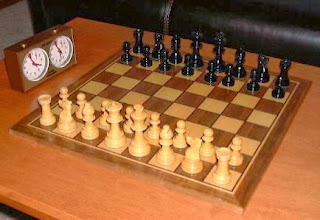
Image: Lee Daniel Crocker
A good, classic example of a game without any luck is of course Chess. While the design is solid and has stood the test of time, I'm not myself a big fan of pure skill games like that. They tend to be a bit too serious and dry for me. Rather, I enjoy games with enough luck to keep things interesting, but not too much to take the feeling of control away. Let's take a look of different ways of adding luck to a game.

Dice rolls in action results


When talking about luck in games, most people think about dices. In chess every action has a clearly defined and guaranteed outcome: a piece always kills the opponent's piece in the square it moves to. In Risk, the result of an attack is decided by a dice roll instead. Games that add uncertainty directly to the action results define the probabilities for different outcomes of the action and then roll a dice to decide the actual outcome. Typically, the player has ways to affect the probabilities and decide the desired actions. The decision is based on the possible rewards/penalties of the action as well as the probability of success. 

Including this kind of a luck element may easily take away the feeling of control: it's natural to think that when I have a 75% chance to succeed, it's a guaranteed success and won't fail. When it does fail (which happens every fourth time in this case),  it often feels unfair, especially if it was an important action. On the other hand, such an uncertainty can add a lot of tension to the game as one can never be sure of the outcome. As such dice is best used for actions that are repeated many times to even out the dice rolls. It is a dangerous approach to be used for major actions that can change the course of the game.

Accuracy


ImageXiaphias
Another way to add uncertainty to actions is to add a dexterity element into the game. Examples of such games include Angry_birds, Jenga, Pool, BowlingDarts and sports in general. Truthfully the accuracy element in this kind of games is directly dependent on the player's skill and thus the word luck does not describe it well. Still, when we compare Chess to the games listed above we notice an interesting difference: Chess is all about strategy and a huge decision space, where one needs to be able to outhink the opponent. Once the move has been decided, the execution will always succeed. In bowling the strategy is very simple: always knock out all the pins. It's the execution part that makes the challenge as even the best players are not able to do that consistently with every throw.

Adding an accuracy element to a game can make otherwise very simple game more interesting and challenging. A good example of using accuracy as a minor element in a game is HellFire. Both HellFire and its predecessor Rage of Bahamut are essentially sophisticated card collection systems with very simple game mechanics. In Rage of Bahamut, battles are decided almost directly by the card stats, while in HellFire the opponents employ weak points to which the attacks should be aimed at by swiping the touch screen. This adds an interesting accuracy element to the battles as skilled swipes give an advantage over poor ones.

Complex action chains


A slightly different approach to accuracy is found from the attacks in Clash of Clans. The game is essentially a multiplayer tower defence game, where players build their villages and decide the defensive tower setup. Then other players use their army to attack the villages and try to steal resources and points. An army may contain over 200 troops. While placing a single troop is simply a tap on the screen, deciding the order, timing and placement of the whole army offers almost endless possibilities.

After being placed onto the field, each soldier automatically attacks based on its behavior model which is defined by its type. The behavior is predictable and thus in theory there is no luck involved, except traps and invisible towers which are hidden information and thus not completely predictable. But even without those, the sheer complexity of the setup means that it's not possible to exactly predict what will happen. It's a common thing to see my troops go to a completely different direction than I predicted and then get slaughtered by a tower they should have destroyed earlier. This unpredictability keeps the attacks interesting as there is always the chance of failure. Yet,  the failure does not feel unfair as the result was not due to an unlucky dice roll but rather the decisions I made.

The challenge in complex action chains is in the execution part similarly to the accuracy element. The difference is, accuracy uses independent actions which should all be executed perfectly. In complex action chains, the actions are are simpler by themselves, but not independent and the goal is to execute the whole action chain flawlessly.

Hidden information


Many people have asked me why do we keep the opponents hand units hidden in Permia - Duels. Wouldn't it be better if all the information was always available to both players, like in Chess? As you might guess, my answer to the guestions is no. But why is that? What do we gain by hiding the information and adding a luck element to the game through that?

Opponent's hand is hidden during a match


In games like Chess, where all information is always available, the only limitation when deciding the strategy is the computational capability of the player's brains. This makes the decision base huge and easily leads to an "analysis paralysis", which means that the players can analyze a single move for ages if the time is not limited. Of course we can limit the time, but again, it becomes a task of analyzing as much of the available information in the given time as possible. For me this kind of games often feel dry and exhausting to play as there are no real surprises, only raw calculations and memorizing chains of moves.

Hiding opponent's units takes away some of the strategic depth and puts more weight on the tactical side. One cannot calculate the exact strategy for the whole game at the beginning as all the information is not available. Rather, the decisions must be based on the own units and their strenghts and one needs to be able to adapt when something unexpected happens. This drastically reduces the decision base at the start of the game and makes the game feel lighter. Additionally waiting for an opponent's moves is more exciting due to the uncertainty: "does he have the unit which wrecks my cunning plan or not?" Rather than knowing all in the beginning, one needs to try to deduce the opponent's hand during the game based on the units he has already played. This adds the possibility for bluffing, which is another element not possible in a full information game. Simply put: for me, games that have hidden information tend to be more fun to play.

Limited options


Another way to reduce the decision base of a game is to limit the options the player has available at once. Good examples are most card games, where the player's hand decides the available actions while the deck defines the whole actions pool. The player typically knows what to expect from the deck and thus has a vision of the grand strategy, but the decisions which cards to use are tactical ones: How to make the best use of the cards in hand, which might or might not be the optimal ones for the situation at hand.

Limiting the options is often used together with information hiding, which allows even more interesting bluffing elements. Limiting the player's options is also an excellent way to make game sessions feel different as the actions available in different phases of the game vary from session to session even if the whole action pool stays constant.

Varied setup


Varying the game setup can also be used for making different playing sessions feel different and to keep the game interesting for a long time. Instead of limiting the options available, the gameboard or gameworld behaves differently from session to another. A good example is Bejeweled, which always generates a different playing field for the game. Varied setup also reduces the advantage gained from memorizing certain chains of moves, as different situations require new solutions.

In Permia - Duels, the varying gameboard is one of the key elements of the game. Differently positioned landscapes form a new challenge for each game session and require the players to their update strategies accordingly.

 Jani Rönkkönen / Lead designer of Seepia Games.

Sunday, 29 September 2013

Permia – Duels


Welcome to the Seepia Games blog also on my behalf! I’m the person responsible for the design of our games and today I will tell you something about our upcoming game: Permia – Duels, from the designer's perspective. You can sign up for the Windows Phone closed beta at http://permiaduels.com/. The game will be released soon for Windows Phone and later for iOS and Android.

As the name suggests, Duels is the first game to be situated in the fantasy world of Permia. Don’t expect to encounter dwarves, elves or even humans though. Permia is populated by completely unique humanoid races and prehistoric animals like dinosaurs. The Permia lore will be revisited later in detail though, so stay tuned! But for now, let’s get back to Duels. 

Seepia Games are all about multiplayer games and Duels is no exception. We wanted to create a collectible card game which can be played in five minutes, is accessible to anyone and still offers enough strategic depth to make you think. To keep games short, the basic mechanics need to be rather simple but still allow new tricks to be added in updates to keep the game interesting in long term.

Two Final Fantasy mini games, Triple Triad and Tetra Master, were both built around the idea of capturing tiles by playing stronger tiles next to opponents. For me, Triple Triad had too little variety as it is always played on 3*3 grid. Tetra Master offers a more varied game board, but the game system feels too random and it does not give enough feeling of control. While neither of the games managed to capture my interest for long, I believe that similar basic idea has a lot of potential when done right and that's where Duels comes in.

Deciding the tile shape was the first big design decision for the game. Using squares would allow either four (Triple Triad) or eight (Tetra Master) attack directions. We decided to go with hexagons instead. The resulting six attack directions give more options than four and give enough room for extending the game in future. Eight directions would make the game harder to grasp and be graphically less appealing.

We tested different versions of the attack system and in the end decided against using any kind of randomization. Instead, the game board is varied each time making games feel different. Especially interesting are the mountain and water land types which prevent normal unit placement. Units with flying or swimming ability can ignore these restrictions though. The game ends either when players run out of tiles or if no more free hexagons exist. Thus players don't know beforehand if all tiles will be played and who will play the last tile. These are affected by decisions to where flying and swimming units are played, which adds an interesting twist to the game.

The last major design issue I want to mention here is the card collection system. One thing I don't like in many collectible card games is that I tend to end up buying cards among which only small portion are usable and majority is excess copies of cards I already own. In Duels, the units can be combined to increase their power. One does not end having a huge collection of useless units but rather the excess units are useful for improving others.

Well, is Permia - Duels a game for you? Probably yes. :) I’m very excited about the game myself. Be wary, though. Our testers tend to get hooked to it, so you might too! Stay tuned for the exact release dates.

Jani Rönkkönen / Lead designer of Seepia Games.